


The White Truffle Fair. In the popular imagination, Italy’s Piedmont region holds the title of the country’s premier truffle territory. This stereotype, however, is incorrect, as the official status of “world truffle champion” has been held for the last half-century by the Italian region of Tuscany. The reason lies in the fact that on October 26, 1954, near the Tuscan town of San Miniato, located halfway between Pisa and Florence, a record-breaking precious white truffle (the most valuable truffle species) was found, weighing 2540 grams. This record still stands, which is why San Miniato rightfully deserves to be considered the truffle capital of Italy and the world at large. Every November, San Miniato hosts Tuscany’s main “truffle celebration”: on weekends throughout November (except the first weekend of the month), the National White Truffle Fair takes place in the center of San Miniato (in 2025, the dates are November 15-16, 22-23, and 29-30). On these days, the town’s streets and squares transform into a “laboratory of taste,” where hundreds of exhibitors present their gastronomic treasures. The main star of the fair always remains the white truffle itself and its culinary variations – olive oil, cheeses, pâtés, cured meats, sweets, and countless hot dishes served in local taverns and restaurants.

Truffle Hunting – All Year Round. Since time immemorial, one of the most respected professions in San Miniato has been that of the “tartufaio” – a truffle hunter. It is no coincidence that it was a local man, Arturo Gallerini, who once found the largest Tuber magnatum pico (White Truffle) ever discovered on the planet in the local woods. Today, anyone can try their luck hunting for truffles – visitors to San Miniato can, at any time of year, join a local tartufaio and his dogs for an expedition into the surrounding forests, or even (for an additional fee) venture into that very legendary forest where the record-breaking truffle was found.
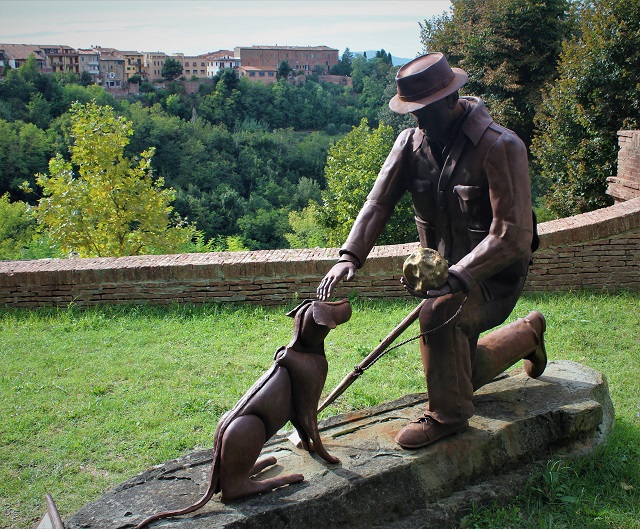
There’s no guarantee you’ll find a new record-breaking truffle, but it’s very rare for anyone to return empty-handed. After the hunt, participants are invited to sample dishes made with fresh truffles, or even to prepare them themselves during a cooking class dedicated to truffle cuisine. The precious White Truffle in Tuscany is typically harvested in October and November, but besides the white truffle, at least five other valuable species of edible truffles grow in this region, ripening at different times of the year, making truffle gathering a year-round activity here. We will detail each of the six seasonal types of Tuscan truffles below.
6 Types of Truffles

White Truffle (Tartufo bianco pregiato, Tuber Magnatum Pico) is considered the most valuable of all edible truffle species (Gioachino Rossini called it the “Mozart of mushrooms” for a reason) and holds significant commercial importance. Because it grows abundantly in Piedmont, it is also known as the “Piedmont truffle” or the “Alba truffle.” Its weight can range from a few grams to a kilogram or more. It has a round, “potato-like” shape and a beige, ochre-yellow, or olive color, depending on the harvesting location and maturity. The outer surface is smooth and slightly velvety, while the inner part (gleba) is beige or yellow-gray with fine white veins. The aroma of the white truffle is the strongest, richest, and most intense among all truffle species, making it unique and the most prized. White truffle is consumed exclusively raw; it should not be cooked. It should be sliced with an appropriate tool, and it is recommended not to wash them but to clean them with a special brush. White truffles grow in cool areas of deciduous forests near linden, oak, willow, and poplar trees in marly, clayey, and sandy soils. The soil must be soft and moist for most of the year, rich in calcium, and well-ventilated. The ripening period for the white truffle is from September to December, with the peak harvest in October-November.
Precious Black Truffle (Tartufo nero pregiato, Tuber Melanosporum Vitt) has a round, uniform shape with a slightly rough, evenly “warty” surface, and its size varies from that of a hazelnut to a tennis ball. The Precious Black Truffle is the most widespread truffle species in the world (besides Italy, it is harvested in France, Spain, Bulgaria, Portugal, and Croatia). The flesh is firm, gray, pinkish-brown, or dark brown to blackish-purple with a white marbled pattern when cut. It has a very strong, characteristic aroma and a pleasant taste with a slightly bitter note. The Precious Black Truffle grows in hilly and mountainous areas in symbiosis with oak, English oak, and hazelnut trees. Commercially, it is considered the most valuable after the white truffle. The ripening and harvesting period for the Precious Black Truffle lasts from mid-November until February-March.
Black Winter Truffle (Tartufo nero Invernale, Tuber Brumale Vitt) is often confused with the Precious Black Truffle because it shares the same habitat and lives in symbiosis with the same types of plants. The mass of a mature fungus can exceed one kilogram. The Black Winter Truffle has a brownish-black, slightly warty surface. The flesh is dark with numerous white or yellowish veins. Its commercial value is on average half that of the Precious Black Truffle. The aroma of the Black Winter Truffle is dominated by notes of nutmeg. The ripening period for the Black Winter Truffle lasts from January to April.

Summer Truffle – Scorzone (Scorzone, Tuber Aestivum Vitt) resembles the Precious Black Truffle but can reach significantly larger sizes. Scorzone is the most harvested truffle in Italy but is found throughout Europe, including Russia, where it is known as the “Black Russian Truffle.” The truffle’s surface is covered with black pyramidal warts and is brown-black or bluish-black in color. The flesh is very firm in young fungi (but becomes soft in older ones), and the color changes with age from whitish to brown-yellow and gray-brown with light “marbled” veins. The flavor of the flesh is nutty, slightly sweet, and the fungus has a pleasant and intense “mushroomy” aroma with hints of nuts and even seaweed. Scorzone grows in clay and sandy soils in broad-leaved forests, usually under the roots of oak, beech, hornbeam, and birch trees. The ripening period for Scorzone typically spans from May to December.
Bianchetto or Marzuolo Truffle (Tartufo Marzuolo Bianchetto, Tuber Borchii Vitt) is traditionally widespread and popular in the Italian regions of Tuscany, Emilia-Romagna, and Marche. Its appearance is similar to that of the precious White Truffle, but the Bianchetto has a significantly lower commercial value; the truffle’s size is also small – from a hazelnut to a tennis ball. The Bianchetto has a round shape, and the color of its surface can be beige, ochre, yellow, olive, or reddish-brown, depending on the harvest location. The flesh (gleba) can be beige or whitish-pink in color. Despite its external similarity to the white truffle, the Bianchetto’s aroma is significantly less complex, with a dominant smell reminiscent of garlic. The ripening period for Bianchetto is from January to April.
Smooth Black Truffle (Tartufo Nero Liscio, Tuber Macrosporum Vitt), despite its excellent qualities, has not yet gained significant commercial importance. The fungus’s surface is smooth with small warts, colored from reddish-brown to black; the size is small – from a hazelnut to a tennis ball. The Smooth Black Truffle is harvested in the same places as the precious White Truffle; it grows near linden, oak, poplar, and hazelnut trees. The fungus has a strong and pleasant smell, reminiscent of the white truffle’s aroma, but unlike the latter, the Smooth Black Truffle can withstand cooking. Excessive consumption can cause poisoning, and it often resembles a small white truffle. The ripening and harvesting period is from July to December.
Where to Stay near San Miniato
The new landscape hotel Villa Petriolo Small Luxury Hotels of the World – is located a 15-minute drive from San Miniato (and 40 minutes from Pisa and Florence). This is one of the best options for a stay in rural Tuscany. The hotel is set amidst its own extensive wine estate and features 4 restaurants (including 1* Michelin), a spa, a fitness center, and a garden – booking.com

The four-star Boccioleto Resort – Place of Charme 4* is located on the edge of a truffle forest. This new hotel offers guests a seasonal outdoor pool, a restaurant, a spa center, a garden, and a shared lounge– booking.com

The four-star Hotel Miravalle 4* is located in the center of San Miniato in a rebuilt 13th-century Palace of Frederick II opposite the Cathedral, with magnificent views of the Tuscan hills. The renovated hotel has preserved its antique decor and furnishings – booking.com
